Cathryn_Conroy
A Sweet, Sentimental Story Written with Flair and Genius: Captivating and Delightful
Cathryn_Conroy
A Sweet, Sentimental Story Written with Flair and Genius: Captivating and Delightful
This book grabbed my heart on page one and never let go. While it's a lot more sentimental than other Ann Patchett books, that's just fine. Sometimes sentimentality is just what we need.
Jonathan and Daphne Fuller are enjoying a rare free afternoon by touring the Metropolitan Museum of Art in their hometown of New York City. At age 70, he is recently retired as a hospital administrator; she is 53 and teaches literature at a posh private girls' school. Jonathan is leaving the next day to fly to Wisconsin to help his sister clean out their mother's house after her death six months ago. As they are strolling through the American Wing, Jonathan notices a strange man following them. Daphne laughs it off. But the man is definitely following them, and eventually Jonathan sidles up to him to find out why.
And what a reason he has for following them! The man is Eddie Triplett, and once upon a time a very long time ago for just a very short time, he was Daphne's stepfather, the second of her mother's three husbands. It was Eddie that Daphne and her younger sister Leda loved the most of their three fathers, but they were only nine and seven when the divorce happened—and poof! Eddie disappeared from their lives forever. Until now. For reasons that made total sense to a nine-year-old, Daphne has always carried enormous guilt because she knows she was the cause of the divorce.
Daphne and Eddie reunite, and this new adult relationship is beautiful, filled with love and laughter, and a bit of sentimentality. Old memories are shared, and new memories are made as they get to know each other all over again.
It is during one of the most poignant scenes in the book that Eddie tells nine-year-old Daphne the story of Whistler, the horse. It's only a few pages long and occurs well into the novel, but that story is the groundwork for it all. (Just so you know, this is not a book about a horse, despite the beautiful cover art.)
And the ending? Oh, it's perfect…I cried happy tears.
This sweet novel is the story of this delightful—often funny and sometimes sad—reunion, and it's written with such flair and genius that it's also a captivating tale that's hard to put down. Most of all, this is a story about forgiveness and love, a very special love that we all wish we could have.

Cathryn_Conroy
Fascinating and Frightening: Why Our Planet Is Heating Up and What That Means—for This Summer and the Future
Stephen King, move over. This book is far more frightening than anything you could write. It's not only a dire warning for the future, but also for today. I read this book during a newsworthy, week-long heat wave, which just emphasized even more the horror of what we are already facing and will be facing in the not-so-distant future.
The heat waves we are experiencing now are not just typical summer weather. They are caused by human beings and the choices we make and have made for the past 200 years. We are doing this to ourselves.
Prodigiously researched and masterfully written by Jeff Goodell, this book explains in basic and often gruesome terms what it means when our planet gets hotter…and hotter…and hotter. While much of the text is scientific, it is always presented in ways everyone can understand. The power of this book is not only in the scientific facts and figures and interviews and opinions of climate experts, but also the personal stories of people who have been tragically affected by intense heat for which they were not prepared.
We're not talking about uncomfortable heat. We're talking about heat that can kill you—and already is killing people every year from Phoenix to Paris and many, many places in between. In 2019, nearly a half-million people died of extreme heat, which is more than all other natural disasters combined. We're talking about heat that melts the asphalt on highways and bends the steel of railroad tracks.
To research this book, author Jeff Goodell traveled around the world, including the Arctic and Antarctica, as well as the hottest cities in Europe and the United States. He also interviewed climate scientists and experts, asking hard questions and gamely deciphering even the most complex answers.
Some of the topics covered in this book include:
• Find out why most life on Earth, including humans, must live in a Goldilocks Zone of temperature and why that Goldilocks Zone is being threatened now.
• We know exactly why the Earth is warming up: the burning of fossil fuels that releases CO2 into the atmosphere. Even if all fossil fuel production globally was stopped this minute, it wouldn't lead to cooler temperatures. All it would do is stop the temps from rising more. Find out some innovative (perhaps crazy??) ideas that might just help.
• Learn how heat-driven chaos exploits the poor and minorities more than anyone else. After all, if you have money, you can turn up the air conditioner; if you're poor, you probably don't even have an air conditioner.
• Find out why climate change is more strongly seen in heat waves than any other weather event. How hot can it get? Could Phoenix, which has seen temperatures as high as 122 degrees, hit 135 degrees or 140 degrees? What are the limits? And how many people will die when those high temperatures become a reality?
• Learn why the largest single global change that threatens food security is high temperatures. In addition, find out the occupations that are most at risk for heat exposure, including construction and farming, and what happens to the human body that toils under these conditions. Note this: In the United States, there are no federal regulations related to heat exposure for workers—inside or outside.
• Find out what is happening in Antarctica and the Arctic and the warnings we should heed from the melting ice. It's not only rising sea levels, but also a new risk for diseases that can spread worldwide.
While this book is fascinating and so very important, it can also feel a bit overwhelming simply because it is so terrifying. After all, extreme heat kills. It's a force for extinction of all life on Earth. Even so, the book should be required reading for everyone, especially our political leaders at the state and federal levels who make the decisions and laws that can help.
And P.S.: Take a minute or two to ponder the deeper and most important meaning of the title of this book.

Cathryn_Conroy
ChickLit Murder Mystery/Thriller: An Entertaining and Smart Summertime Novel
The air is hot and sultry. And another hurricane is forming in the Caribbean with it's eye on St. Medard's Bay on the Gulf Coast of Alabama. Here's a word to the wise: Not everyone who dies during a hurricane in St. Medard's dies from the storm. Sometimes people are murdered during hurricanes in this tiny beach town.
Written by Rachel Hawkins, this ChickLit murder mystery/psychological thriller/suspenseful soap opera novel (yes, it's quite the genre mish-mash) is a gripping page-turner.
This is the story of Geneva Corliss, a 40-year-old unlucky-in-love woman who has taken over running the Rosalie Inn, a beachfront hotel her family has owned for generations. The inn has an eerie reputation: When hurricanes strike St. Medard's, which they seem to do with great regularity, the Rosalie survives when so many other structures are destroyed.
Worried about the financial impact of so many empty rooms at the Rosalie, Geneva is thrilled when a writer named August Fletcher calls to book two rooms for an indefinite period of time for himself and the subject of a book he is writing. The subject in question is Gloria Bailey, who goes by Lo and grew up in St. Medard's. Lo has quite the reputation. Beautiful and sexy, she had an affair at age 19 with Landon Fitzroy, who was 11 years older and the son of the governor. When he turned up dead in a hurricane in 1985, his injuries were not consistent with a vicious storm—more like a vicious human being. Lo was arrested and tried for murder, but a hung jury resulted in her release. Now she is back, hoping to write her memoir with August and finally set the record straight.
Ah, but nothing is as simple or straightforward as it would seem. Lo has secrets…lots of them. And one by one, she spills them, shocking Geneva and August and making Geneva wonder if Lo returned to St. Medard's not to write a book but to get revenge.
Oh, and guess what? Another hurricane—Hurricane Lizzie—is headed straight to St. Medard's. Who will survive? Who will die? And will anyone be murdered? (And for what it's worth, fairly early on I thought I had figured out Landon Fitzroy's murderer…and I was almost right save for a major twist to it all.)
Rachel Hawkins cleverly and seamlessly tells the story from each character's point of view—some of whom are more reliable and truthful than others—as well as going back and forth in time.
As the temperatures rise and the monster storm approaches, the electrifying plot simmers with tension making this an entertaining and smart summertime novel—even if it does read like a soap opera at times.

Anthony_Conty
Are We All the Last of Our Kind?
“Endling” refers to the last remaining member of a species. If that was not new information to you, I apologize, but I had no idea. Titles with double meanings rock! Maria Reva, a Ukrainian author, tells a unique tale of kidnapping, wartime suffering, and sisterhood that reads like nothing I have ever read. Ukraine is known for its sharp, biting wit.
You cannot set a novel in Ukraine in 2022 without the war becoming a character, even if the heist is the main story. Too much was going on then. The author makes an ambitious attempt at a faux-finis and ends the story on page 140, complete with acknowledgments and “About the Author,” leaving me confused about the remaining 198 pages.
One of the main characters is Pasha, a Canadian with good intentions who gets caught up in the hostage situation. The men obviously worry about themselves while focusing on the war as it relates to their nation and their individual selves. Some parts drag on, but readers will appreciate the marked chaos characteristic of a war-torn atmosphere.
Having relatives in Canada, Ukraine, and Russia gives you a multi-faceted perspective of the conflict. Few supported violence but appeared resigned to a long period of strife, making the rest background noise. Focusing more on the cultural and political aspects may have kept me more interested, since a misguided sub-plot at the end of the novel distracted me more than it added.
The ending is special and ties everything together, but if someone gave me a quiz on the third or fourth, I might fail. War today is unorganized chaos, and that led Reva to create little chaos that probably means more than my mind can process. Politics aside, it is hard to imagine normalcy, order, or calm in Ukraine right now.

Cathryn_Conroy
An Intense, Pressure-Pounding Thriller/Mystery That Is Grounded with Compassion and Caring
This psychological thriller by Chris Whitaker is by turns frightening and gentle, heartbreaking and heartwarming. It reached out and grabbed my heart (and sometimes my throat) and wouldn't let go.
It's 1975 in Monta Clare, Missouri. Joseph Macauley, 13, is nicknamed Patch because he was born with only one eye and wears a patch, something his mother told him from a young age made him a pirate. He and his mother are desperately poor. Patch's only friend is Saint Brown, an orphan with big glasses and ill-fitting clothes, who lives with her widowed grandmother. Saint is fascinated with nature—from bees to birds. Both Patch and Saint endure much ridicule from their classmates and the townspeople.
One day as Patch is cutting through the woods on his way to school, Patch hears a girl scream—a frightened, terrified scream. He runs toward it to find that Misty Meyer, the most popular girl in school who is from the wealthiest family in town, is being assaulted by a strange man. Patch intervenes, which allows Misty to run away, but Patch is captured by the demon. He awakens in a pitch black room and quickly realizes there is someone else in the room with him, a girl named Grace. She tells him that she is the only one who has survived this brutal man's killing spree of teenage girls. And Grace says she has done this by loudly reciting biblical scriptures whenever the man—Eli Aaron—comes near them.
Meanwhile, Saint is obsessed with finding Patch, and even though she is only a young teenager, she nags and prods the police to do more. It's not a spoiler to say that Patch is rescued (although I won't reveal the drama behind it) because the rest of the book is about both Patch and Saint's mutual obsession with finding abducted girls—even if all they find are their bones. Everything these two become and do as adults is determined by this one act of evil perpetrated on young Patch that day in the woods.
As much as this is a page-turning thriller/mystery, it is also a perceptive novel about human endurance when hope is all there is—and even when there isn't much of that. It is a story about the many kinds of love that keep us all alive.
This is an intense read, sometimes a pressure-pounding and unsettling read, because the subject matter is so chilling and formidable. But through it all, it is grounded in compassion and caring.
And the ending? Let's just say is surprising, astounding, and very (very!) good.
True to the title, this book presents a palette of colors through words, painting mind-pictures with color names that reach far beyond our typical lexicon, from ochre to titanium white, from viridian to carbon black, from cardinal to mulberry. In fact, the descriptions of color—from a young woman's eyes to a church's stained glass windows—are breathtaking. I've never read anything like it.
Not only is the novel filled with color symbolism, but also colors serve as a metaphor for finding a greater meaning in life when all is covered in darkness.

Cathryn_Conroy
A 10-Star Book in a 5-Star World: A Deeply Resonant Novel About Human Connections and Loneliness
Oh, this book. This is a ten-star book in a five-star world! Written by Pulitzer Prize-winning author Elizabeth Strout, this is a novel for our times—our angst-filled political times when the world seems as if it has turned upside down and we are incapable of righting it.
This is the story of Artie Dam, a beloved high school history teacher, whose 11th grade students—even (or maybe especially) the troubled, insolent ones—learn so much from him, not only about the Civil War, but also about life. Artie, who is 57, has been married to Evie for 34 years, and they have a grown son, Rob, who is 27. The couple live in an extraordinary, light-filled home that overlooks the Massachusetts Bay, a house that Evie inherited from her parents and one they could never afford to buy now.
Artie, who is an accomplished sailor and loves nothing more than spending time on the water in his boat, doesn't understand why he is experiencing frequent thoughts of suicide. He doesn't particularly want to die, but he doesn't want to keep living. One day Artie has an accident while trying to board his sailboat, and he realizes then that he does want to keep living. It is soon after the accident that a shaken Rob tells Artie a shocking and life-altering secret someone recently confided to him. Life-altering, indeed. Somehow Artie has to learn to live with this long-buried secret, and this makes him realize how much we lie to each other. Meanwhile, Artie keeps going to school and teaching his students, making such a significant difference in so many young lives.
Very subtly overshadowing all of this is the 2024 presidential election, the results of which left half the country jubilant and the other half stunned. Artie is one who is stunned, and this colors his deepest feelings about his personal life with a sense of wariness and weariness.
This book is about both the deep connections we make with other people by showing kindness and compassion, especially to strangers, as well as the deep loneliness each of us often experiences. After all, even those we love the most never really know the deepest secrets of our souls. Ultimately, each one of us is alone. And we have to figure out how to live that way—with all the things we never say.
Bonus: This is also a love letter to that one favorite teacher we all remember. Teachers, especially those who truly feel called to the profession, are essential and vital to our society and make such a difference in their students' lives. Yay for teachers!

Anthony_Conty
They Need to Teach This in American Schools
Taiwan has an immense, rich history for a land the size of Maryland with a population about the same as Florida. You could spend forever on their relations with China and Japan. “Taiwan Travelogue” by Yang Shuang-zi focuses on a curious Japanese novelist in Taiwan who falls for her Taiwanese interpreter on a culture bus-esque trip around the island nation.
Although I expected to learn some things, I did not expect so much about food, leading me to realize that I know less about Japanese and Taiwanese cuisine than I previously thought. Luckily, like any worthy translator, King takes a lot of time to teach you new vocabulary, though those of average aptitude will need to look back a few times.
For about the third time this year, Goodreads spoiled a plot twist by naming a genre that would not apply unless “something” happens that did not even begin to occur by the middle of the novel. This did not detract from the cultural experience I enjoyed, but it does not allow the reader to discover things organically.
The most engaging parts take the form of dialogue, when you can really see the bizarre relationship between the two women evolve and devolve. Can you ever truly love your implied oppressor? Are conflicts between individuals and those between cultures often the same thing? With so much left unspoken, the risk of misunderstanding increases. A language barrier only exacerbates these difficult moments.
If you tend to skip over the author’s notes at the end of the book, I would recommend giving them a chance here. So many writers and translators kept this story alive, and I forgot that we were reading about real people. They do not teach us enough about Taiwan and Japan in school, and we would benefit from learning.
Anthony_Conty
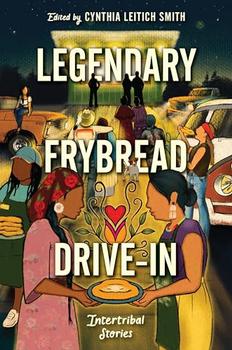
A Community I Barely Knew
People sometimes interpret reading books from minority cultures as virtue signaling, but I see it as an essential way to genuinely learn about communities I wouldn't otherwise encounter. With only two personal interactions with Native Americans—both culturally involved and memorable—I turn to books like this, which centers on a Frybread Drive-In, as a way to connect with authentic voices through stories by prominent Native authors.
The selections are true YA as far as the characters are concerned, but a lot of deeper meaning hides here. The bonds formed at the Frybread Drive-In connect seemingly separate individuals across different tribes, revealing how their paths intersect. You will find various lengths of writing and even an intense dose of poetry by Kaua Mahoe Adams that will resonate with you if you have ever felt that your anxiety was too much.
As often happens with collections of multiple voices, the audiobook comes highly recommended. Among the selections, I particularly enjoyed Kaua Mahoe Adams’s verse and the heartfelt, simple emergency baking in Andrea L. Rogers’ “You Had One Job.” For those who have lost a loved one, “I Love You, Grandson” by Brian Young offers clear, poignant resonance.
Continuing with the standout stories, “Hearts Aflutter” by A.J. Eversole captures the nuances of young love and confusion, evoking the awkwardness of first dates between people not quite ready. In “Jilly Bean and Jessa Jean,” Angeline Boulley—author of “Firekeepers’ Daughter”—thoughtfully explores youth relationships, attuned to a generation’s challenges in forging connections.
Successfully creating a YA collection that allows readers to truly meet and understand a diverse community is rare. This book achieves that, making the whole greater than the sum of its parts and offering readers not just entertainment, but an introduction to voices they might otherwise miss.

Cathryn_Conroy
A Contemplative Novel About Healing and Hope, Secrets and Confessions, Forgiveness and Understanding
This is a quiet and contemplative book with very little plot; instead, it's a character study that is both profound and deeply sad. Like "Gilead" and "Lila," this novel philosophically examines life's biggest questions, but in this case it does so in a retelling of the Gospel of Luke's parable of the prodigal son: How do we forgive, especially ourselves? Why are we here? What is a soul? What is a family? Who is God? What does it mean to die?
Written by Marilynne Robinson, this novel continues the story of the Rev. Robert Boughton in his old age as he is nearing death. Retired as a minister in the Presbyterian church, he is a widower and the father of eight children, all of whom have moved away from their hometown of Gilead, Iowa. The youngest, 38-year-old Glory, a schoolteacher who was burned by a young man she thought of as her fiancé, has moved back to Gilead to care for her father in his last days. Surprising both of them, her brother Jack—the black sheep of the family, who has been incommunicado for 20 years and up to all kinds of mischief and misdeeds—suddenly appears on their doorstep. And while the other seven children did exactly what their parents expected, Jack did not. Yet, he remains his father's favorite child.
It's a hot summer in 1956. This is the story of the three of them as Rev. Boughton slowly dies and Glory and Jack begin to come to life again after experiencing heartbreak, disappointment, and despair. Jack is harboring some big secrets, and he's not disclosing any of them—for now. Meanwhile, he and Glory, who barely knew each other as children, begin a cautious and ever-so-careful dance toward one another, eventually forming a tight, loving bond as they both try to heal. Still, it's difficult. Jack is hostile. Jack is a thief, a liar, a coward, and a drunk. And Glory is suffering from her own secretive heartbreak.
This is a book that seems almost like a kind of prayer…a prayer for healing and hope, secrets and confessions, forgiveness and understanding.
As I wrote in my review of "Gilead: A Novel," this quartet of novels is an intelligent and accomplished literary achievement. Read this and the other three because they are masterpieces, but don't expect a compelling, page-turner of a story.
Unlike most book series, you do not need to read these novels in any particular order. They each—"Gilead," "Home," "Lila," and "Jack"—blend into the others in an imaginative way. And while each one stands alone, together they form a resonant whole.

Cathryn_Conroy
Literary Comfort Food for the Soul: A Lovely and Heartwarming Escape from the Real World
This is a lovely, thoughtful, and heartwarming escape from the real world. It is filled with joy and love. I call it literary comfort food for the soul.
Florence Greene is 92 years old, a widow who lives alone in the house she and her beloved husband, Terrence, owned for decades. Flo has just found out that she has four to six weeks to live, so she is spending this last precious bit of time writing a very long letter to Ruthie, the little girl who grew up in the house next door. Flo and Terrence weren't able to have children of their own, so Ruthie was a substitute. She spent hours and hours in their home, talking to Flo. And now Flo is leaving the house and all its contents to Ruthie, who is married with children of her own.
Flo describes the letter as an autobiography of things in the house and what they mean to her: a rubber band that is in a matchbox tied with a ribbon, a giant safety pin, a Mrs. Hen coffee mug, a metal box filled with recipes, and a teddy bear who lives in a blue cardboard suitcase, to name just a few.
About half the book is epistolary—the letter that Flo is writing to Ruthie to be delivered upon her death. The rest of it is the story of Flo's life past and present, as well as the people she is meeting now, mostly new neighbors and a funny encounter with Mimi the librarian. Oh, and Flo gets the first pedicure of her life and along with it a blue streak dyed in her hair.
This is a sweet, lovely novel with delightful characters and a simple plot that will light up your day. It is filled with solid life advice, offered in a tender and wise way. Like so many of Elizabeth Berg's books, especially the "Arthur Truluv" series, this one brilliantly captures the magnificence of life—and in this case, life at the end of life.
It's a treat! This is ChickLit at its finest.
Bonus: There is a fabulous recipe for corn-on-the-cob on page 51. (I read this on a Kindle, so the page numbers are a little wonky. If it's not page 51, it's close to it.)
Another bonus: The book cover is gorgeous!